
November 02, 2026
Hoshizaki Ice Machine Filter Guide: Change Intervals and Compatible Inline Options
Hoshizaki ice machines are built to run for years, but the water feeding them determines how clean that ice looks and how long the machine's internal components last. Sediment, chlorine taste, and scale-forming minerals all pass straight into the ice bin unless something stops them first. If you run a Hoshizaki unit and haven't thought about filtration beyond "there's a cartridge in there somewhere," here's what actually matters.
What Hoshizaki Machines Need From a Filter
Hoshizaki's own factory filters are designed to reduce sediment, chlorine taste and odor, and scale buildup on the evaporator plate. That's the baseline every ice machine needs, regardless of brand. The two water-quality issues that cause the most service calls are scale (from hardness minerals) and sediment or chlorine carryover from municipal supply lines. Left unfiltered, scale coats the evaporator and slows ice production; sediment can clog fine water passages and shorten component life.
A correctly sized inline filter handles both of those for normal municipal water. It does not replace a water softener if your incoming water is genuinely hard - more on that below.
How Often to Change the Filter
Change interval depends on water quality and machine usage, not a fixed calendar date. High-volume bars and restaurants running ice machines constantly, or locations on harder or sediment-heavy water, will need more frequent changes than a low-volume back-bar unit on clean municipal water. As a general rule, check filter performance and flow rate regularly and don't wait for visibly cloudy or off-tasting ice to replace the cartridge - by that point, scale may already be forming inside the machine.
If you're also running a Manitowoc unit in the same kitchen, the filtration logic is the same: match filter capacity to combined daily water draw, not per-machine guesswork.
Compatible Inline Filter Options
For a single Hoshizaki ice machine on municipal water, a point-of-use inline filter ($44.95) covers basic sediment and chlorine reduction for one machine and is the simplest replacement option.
If you want a longer-lasting cartridge with higher flow capacity, the Commercial Single Inline Water Filter ($89-$129) is built for steadier commercial duty cycles - a better fit for machines running most of the day.
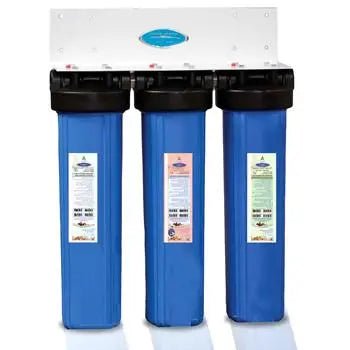
Running more than one ice machine, or an ice machine alongside a beverage dispenser or espresso equipment on the same line, is where a Commercial Triple Inline Water Filter ($149-$189) earns its cost. Triple-stage filtration handles higher combined flow without becoming the bottleneck in your line.
When a Filter Alone Isn't Enough
If your water is genuinely hard - visible scale on faucets, fixtures, or glassware - an inline filter will slow scale buildup but won't eliminate it. That's a job for a dedicated softener like the light commercial softener (30,000-60,000 grains), installed ahead of the ice machine's filter.
If you're filtering water for multiple pieces of equipment across the whole kitchen or bar - ice machines, coffee, dish prep - it's worth looking at whole-location pre-filtration with something like the whole-location pre-filtration system, rather than stacking individual point-of-use filters on every line.
Sizing It to Your Kitchen
A single back-bar ice machine and a high-volume kitchen running three ice machines plus a dish station don't need the same filtration setup, even though both are "Hoshizaki equipment." If you're not sure where your location falls, the Food & Beverage Water Filtration Systems page breaks down options by equipment type, and the restaurant buyer's guide walks through sizing by total water volume across your whole operation.
Not sure which inline filter fits your Hoshizaki setup, or whether you need softening or whole-location pre-filtration too? Request a quote and tell us your machine count and water conditions - we'll size it correctly the first time.