
October 02, 2026
RO Membrane Review for Better Drinking Water
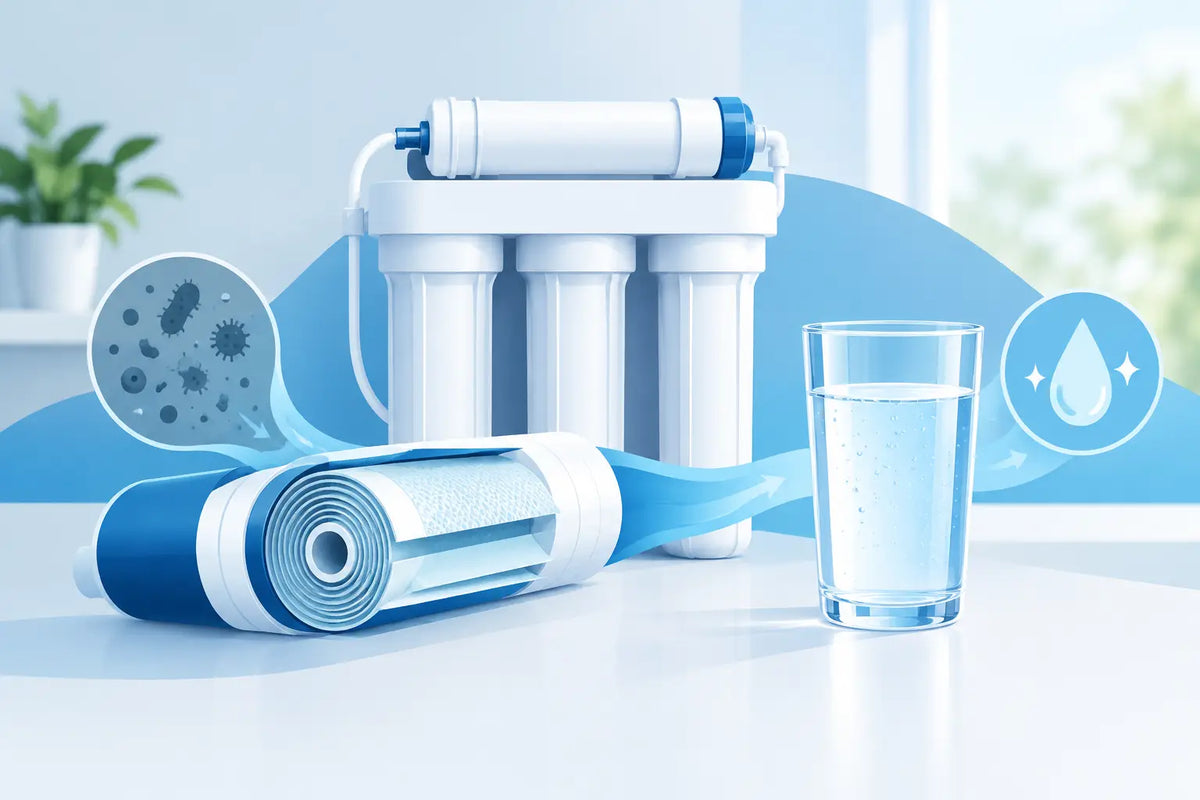
A reverse osmosis system can look perfectly normal while its membrane is quietly losing performance. Water may still flow from the faucet, but taste can decline, total dissolved solids can creep upward, and contaminants may not be reduced as effectively as they should be. This RO membrane review explains what separates a dependable replacement membrane from one that creates more questions than confidence.
For homeowners, the membrane is the working core of an RO drinking water system. For restaurants, offices, and light commercial facilities, it also affects water consistency, service intervals, and the performance of downstream equipment. Choosing the right one is less about finding the lowest price and more about matching membrane capacity, size, water conditions, and system design.
What an RO Membrane Actually Does
Reverse osmosis uses water pressure to push water through a tightly wound semipermeable membrane. The membrane allows purified water to pass through while sending a concentrated stream of dissolved minerals, salts, and other rejected material to the drain. It is the component responsible for the high level of reduction people expect from an RO system.
A quality RO membrane can reduce many dissolved contaminants, including sodium, lead, fluoride, arsenic, nitrate, and chromium, depending on the membrane specification, incoming water, and operating conditions. It should not be treated as a universal guarantee for every water concern, though. Some contaminants require additional treatment stages, and water with bacteria, sulfur, heavy sediment, or high hardness may need pretreatment before it reaches the RO system.
That distinction matters. An RO membrane is highly capable, but it performs best as part of a properly built system with the right sediment and carbon prefilters.
RO Membrane Review: The Specs That Matter Most
Membrane packaging can be full of numbers, but a few specifications deserve the most attention when comparing options.
Rejection rate
The rejection rate tells you how effectively a membrane reduces total dissolved solids under rated test conditions. A higher rejection rate generally means cleaner product water, but the number should be viewed realistically. Actual results change with water temperature, pressure, feed-water TDS, pH, membrane age, and the condition of prefilters.
For example, a membrane rated for high TDS rejection may produce excellent water when fed with moderate-TDS municipal water at proper pressure. The same membrane may deliver a different result on cold well water, very hard water, or water with unusually high dissolved solids. A handheld TDS meter is useful for monitoring trends, but it does not identify specific contaminants or replace water testing.
Gallons per day capacity
Capacity is usually expressed as gallons per day, or GPD. Common residential membrane capacities include 50, 75, and 100 GPD, while commercial membranes can be significantly larger. More capacity is not automatically better.
A larger membrane may be a good fit for a busy family, a home with multiple RO water uses, or a small business that needs more purified water on demand. But it must be compatible with the system's flow restrictor, tank, tubing, pressure, and housing. Installing a higher-GPD membrane without matching those parts can reduce efficiency or compromise water quality.
Physical fit and configuration
A replacement membrane must fit the housing and work with the system's connections. Residential systems often use standard membrane sizes, but dimensions, end-cap styles, and flow direction can vary. Commercial systems require even closer attention to membrane size, vessel configuration, and operating parameters.
Before ordering, verify the membrane length and diameter, rated GPD, housing type, and whether your system uses a standard residential membrane or a proprietary cartridge. When in doubt, use the existing membrane label and system model as the starting point rather than relying on appearance alone.
Certifications and manufacturer consistency
Trustworthy membrane performance starts with a reputable manufacturer and clear specifications. Look for products that provide usable technical details instead of broad promises. In a drinking water application, consistency matters: a membrane that fits properly and performs predictably is worth more than an unverified replacement that may vary from one batch to the next.
When a Membrane Replacement Is the Right Move
Most residential RO membranes last roughly two to five years. That range is wide because incoming water quality and maintenance habits matter more than the calendar alone. Hard water, iron, chlorine exposure, sediment, and skipped filter changes can shorten membrane life considerably.
Consider replacing the membrane when you notice several of these changes together:
- Purified water TDS is rising compared with your normal baseline.
- Water taste is noticeably less clean after carbon postfilter replacement.
- The system produces water much more slowly than usual.
- The membrane has reached the end of its expected service life.
Pretreatment Protects Membrane Performance
The best membrane cannot overcome neglected pretreatment. Sediment filters protect the membrane from dirt, rust, and suspended particles. Carbon filters reduce chlorine and chloramine exposure, which is especially important because standard thin-film composite membranes can be damaged by chlorine. In hard-water areas, a water softener or scale-control strategy can reduce mineral fouling and help the system maintain performance.
Well water deserves extra attention. If water contains iron, manganese, hydrogen sulfide, heavy sediment, or microbial concerns, those issues should be addressed before reverse osmosis whenever possible. An RO system is typically designed for point-of-use drinking water, not as the first line of defense for untreated problem well water.
For commercial applications, pretreatment should be based on a water analysis and expected daily demand. A restaurant, coffee service, laboratory, or facility cannot rely on a generic membrane selection when feed water conditions and production requirements are specific. Proper sizing protects both water quality and operating cost.
How to Judge Results After Installation
A new membrane needs to be installed carefully and flushed according to its instructions. During installation, sanitize the system if appropriate, replace exhausted prefilters, inspect O-rings, and confirm the flow restrictor is correct for the membrane capacity. An old carbon filter or mismatched restrictor can make a new membrane look like it is underperforming.
After the system has run and the storage tank has filled, compare product-water TDS with incoming-water TDS. The calculation for rejection percentage is straightforward: subtract product TDS from feed-water TDS, divide by feed-water TDS, and multiply by 100. The result is useful for tracking membrane health over time, not for proving removal of any individual contaminant.
Taste is also a practical indicator, especially after the postfilter has been changed. Still, if you are concerned about a specific issue such as PFAS, arsenic, lead, nitrate, or private well contamination, use a targeted water test. The right treatment decision begins with knowing what is actually in the water.
Choosing the Right Membrane for Your Water
For a typical city-water household, a correctly sized standard residential membrane paired with on-schedule sediment and carbon filters is often the sensible choice. A larger family may benefit from higher production capacity, but only if the entire system supports it.
For hard water, well water, or high-TDS water, membrane selection should follow a closer look at pretreatment and pressure. For commercial systems, production demand, recovery rate, storage capacity, and service access all affect the right specification. This is where expert system matching prevents a common mistake: buying a membrane that sounds more powerful but does not fit the application.
Pure water is not a place to guess. If your current RO system is producing less water, testing higher in TDS, or no longer delivering the taste you expect, start with your water conditions and system specifications. The right membrane, protected by the right filters, helps keep every glass dependable.