
October 04, 2026
7 Best Microplastic Water Filters for Your Home
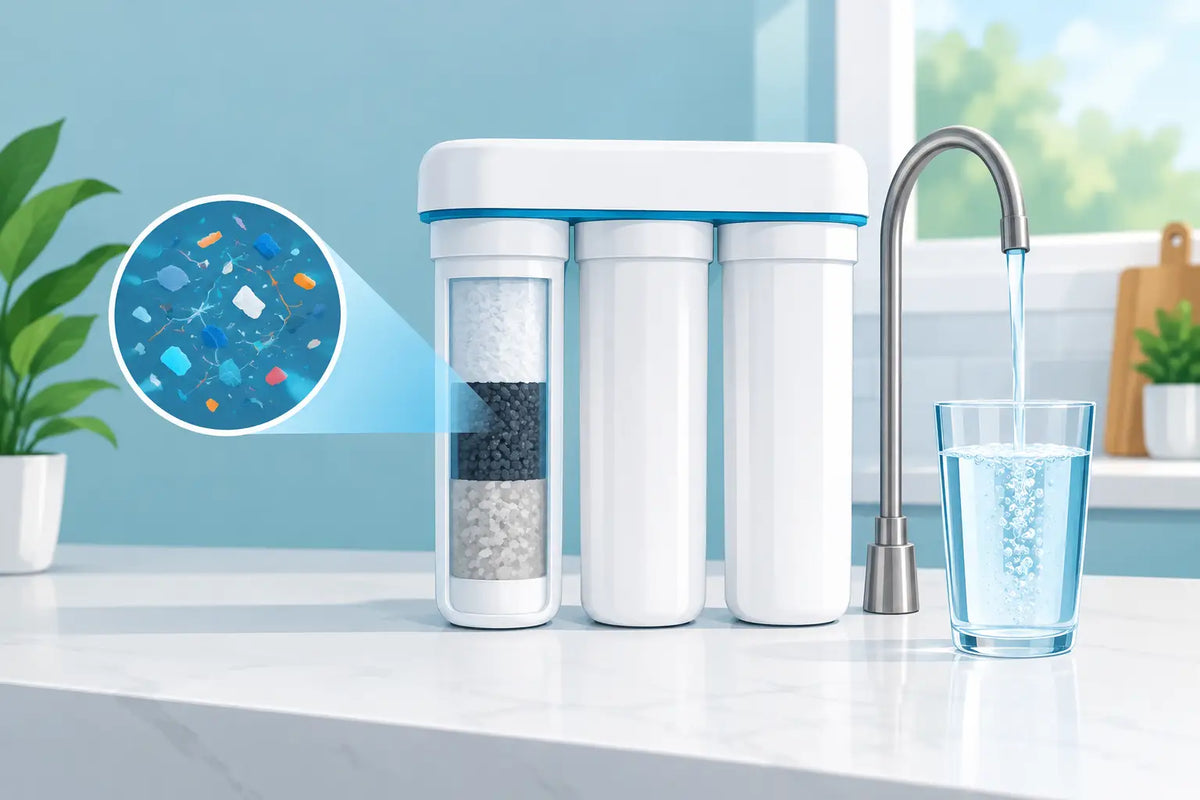
A plastic water bottle is an obvious concern. The smaller particles you cannot see are harder to evaluate. The best microplastic water filters use a physical barrier fine enough to reduce particles at the point where you drink, cook, or fill a bottle. But the right system depends on your water source, household demand, and whether you need protection at one faucet or throughout the property.
Microplastics are not one uniform contaminant. They vary widely in shape, material, and size, and the smallest particles can approach the scale of nanoplastics. That is why broad promises deserve a closer look. No home filter can credibly guarantee complete removal of every plastic particle under every water condition. A well-chosen system can still provide meaningful reduction, especially when it pairs the right filtration technology with proper installation and cartridge maintenance.
What Makes a Filter Effective Against Microplastics?
For particle reduction, pore size and membrane design matter more than a marketing label. Reverse osmosis uses a semipermeable membrane that rejects a wide range of dissolved contaminants and very small particles. Ultrafiltration uses a finer physical membrane than standard sediment filtration and can reduce many suspended particles while retaining beneficial minerals. Sediment filters catch larger debris, but their micron rating must be matched to the particle size they are designed to capture.
Activated carbon remains valuable for chlorine, unpleasant taste, odor, and certain organic contaminants. It is not, on its own, the primary physical barrier for very small microplastics. In many effective systems, carbon is part of a treatment train: sediment filtration protects the system, carbon improves water quality, and a membrane handles fine particle reduction.
Third-party performance data and clear micron or membrane specifications matter. Be careful with vague claims such as “filters plastics” that do not identify the filtration method, operating conditions, or replacement schedule. Your water may also have hardness, iron, sediment, chlorine, PFAS, or well-water concerns that should be addressed alongside microplastics.
7 Best Microplastic Water Filters by Home Need
1. Under-Sink Reverse Osmosis Systems
For most homeowners focused on drinking and cooking water, an under-sink reverse osmosis system is the strongest all-around choice. Its membrane provides a very fine barrier and also reduces many other contaminants that families commonly want to address, including dissolved solids, lead, and certain PFAS compounds when the system is properly specified.
The trade-off is that reverse osmosis produces a concentrate stream and requires periodic filter and membrane changes. It also needs room beneath the sink for a tank or a compact tankless unit. If clean, high-quality water at the kitchen faucet is the priority, this is often the most practical investment.
2. Tankless Reverse Osmosis Systems
Tankless RO systems bring the same core membrane approach into a space-saving design with on-demand production. They are a good fit for modern kitchens, smaller cabinets, and households that prefer a dedicated faucet with less equipment stored below the counter.
Check the system's production capacity and feed-water requirements before buying. Larger families may need higher daily output, while very hard water may call for pretreatment to protect the membrane and keep performance consistent.
3. Ultrafiltration Drinking Water Systems
Ultrafiltration, often called UF, is a strong option when you want fine physical filtration without the wastewater associated with reverse osmosis. UF membranes can reduce suspended solids, bacteria, and many microplastic-sized particles while generally allowing dissolved minerals to remain in the water.
It depends on the source water. UF does not reduce dissolved contaminants to the same degree as RO, so it may not be the right standalone answer for elevated TDS, certain PFAS concerns, or other dissolved-water issues. For municipal water with acceptable chemistry but concerns about fine particles and taste, it can be an efficient point-of-use choice.
4. Whole-House Sediment Filtration Plus Reverse Osmosis
This combination is often the best balanced setup for families who want cleaner water throughout the home and the highest level of treatment at the kitchen sink. A whole-house sediment filter reduces grit, rust, and larger particulate matter before it reaches plumbing fixtures, water heaters, and appliances. An under-sink RO system then delivers highly treated water where it matters most for consumption.
This approach avoids overspending on whole-home membrane treatment when the primary concern is drinking water. It also gives the RO system cleaner feed water, which can support longer cartridge and membrane life.
5. Whole-House Ultrafiltration Systems
A whole-house ultrafiltration system makes sense when fine particle reduction is needed at multiple fixtures, such as kitchen taps, bathroom sinks, and refrigerator lines. Property owners with visible sediment, private water supplies, or a strong preference for filtered water across the home may appreciate the broader coverage.
Whole-house UF requires careful sizing. Flow rate, peak household demand, water pressure, and the quality of incoming water all affect results. A system that is too small can create pressure loss during showers, laundry, or simultaneous fixture use. For larger homes, system specification matters as much as the membrane itself.
6. Carbon Block and Fine Sediment Filter Combinations
A quality carbon block filter paired with fine sediment filtration can be a sensible entry-level option, particularly for municipal water with chlorine taste and low sediment. The sediment stage captures larger particles, while the carbon stage improves flavor and odor and can reduce select chemical contaminants.
This is not the same level of microplastic protection as a properly designed RO or UF membrane system. Still, it can be a useful first step when budget, space, or rental restrictions rule out a more involved installation. Choose published micron ratings and replace cartridges on schedule, not only when water flow drops.
7. Commercial Reverse Osmosis and Ultrafiltration Systems
Restaurants, offices, laboratories, multifamily properties, and light industrial facilities may need a higher-capacity solution. Commercial RO and UF systems can be designed around daily volume, peak demand, incoming water chemistry, and the equipment being protected.
For a food service operation, water quality can affect beverage flavor, ice clarity, steam equipment, and maintenance costs. For a facility, the goal may be reliable point-of-use water for staff or process applications. These systems should be specified with a water analysis and realistic flow requirements rather than selected by cartridge size alone.
How to Choose the Right System
Start with the water you actually have. City water and well water can require very different treatment plans. Municipal supplies may benefit from chlorine reduction and membrane filtration at the kitchen sink. Well water may need sediment, iron, sulfur, hardness, or bacteria treatment before a fine-pore filter can perform as intended.
Next, decide where filtered water is needed. A point-of-use system is typically the best value when your concern centers on drinking, cooking, coffee, infant formula, and pet water. A whole-house system is more appropriate when sediment affects fixtures, laundry, appliance performance, or water quality at multiple taps.
Also account for ownership costs. Replacement filters, membrane life, wastewater, installation space, pressure requirements, and service access are part of the decision. A lower-priced filter that needs frequent changes or restricts flow may cost more frustration over time than a properly sized system from the start.
Installation and Maintenance Protect Performance
A filter only works as designed when it is installed correctly and maintained on time. Replace sediment and carbon cartridges according to the recommended interval or sooner when source water is unusually dirty. Delayed changes can reduce flow, allow taste and odor issues to return, and place extra stress on downstream membranes.
For reverse osmosis systems, monitor performance through filter indicators, water taste, flow, and periodic TDS checks where appropriate. For whole-house systems, use pressure gauges if available and watch for a growing pressure drop across the filter. This is especially useful for well water and high-sediment areas.
If you are comparing membranes, micron ratings, or whole-home flow requirements, an expert recommendation can prevent a costly mismatch. Pure Water Guys can help match filtration to your water quality, household size, and treatment goals. The right system should feel straightforward: water that tastes better, equipment that stays protected, and a plan you can maintain with confidence.