
June 15, 2026
Choosing a Commercial Reverse Osmosis System
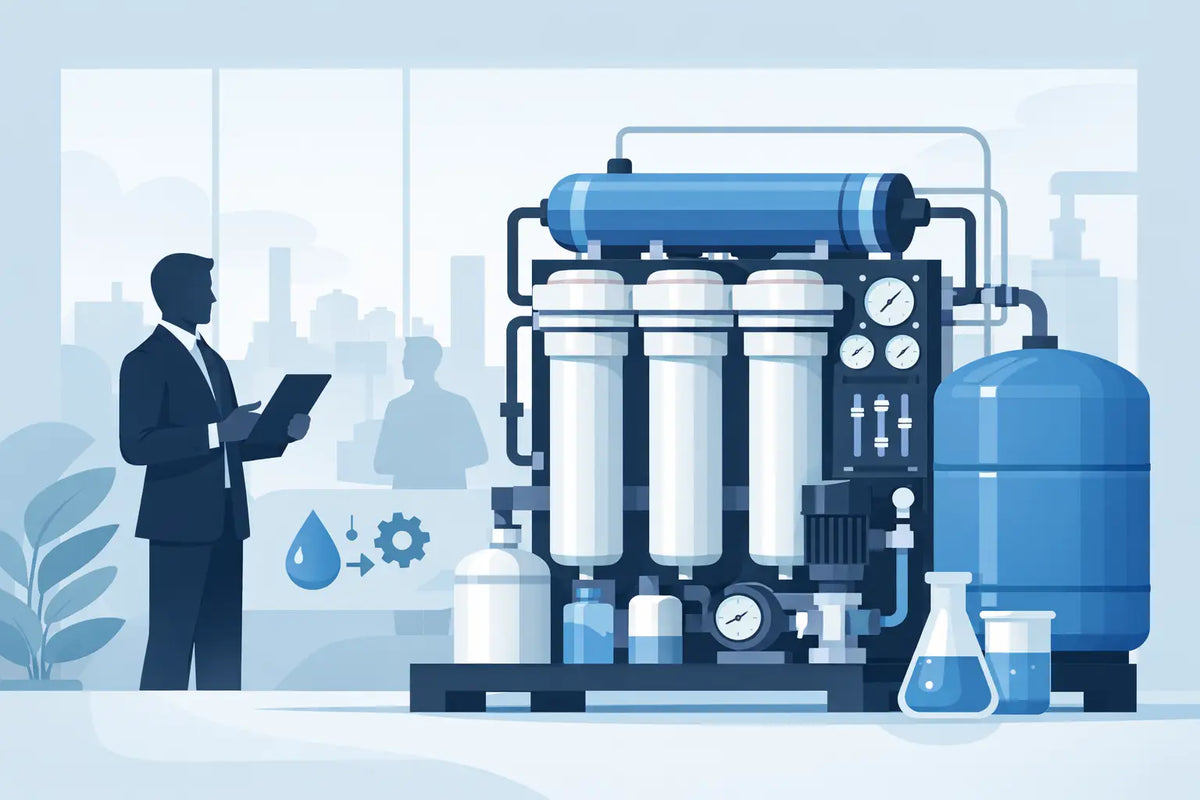
A restaurant that burns through ice machines, a lab that needs consistent low-TDS water, and an apartment building trying to protect equipment all have one thing in common - guessing on a commercial reverse osmosis system gets expensive fast. When water quality affects product quality, uptime, and maintenance costs, the right system is not just a nice upgrade. It becomes part of daily operations.
What a commercial reverse osmosis system actually does
A commercial reverse osmosis system uses pressure and a semipermeable membrane to reduce dissolved solids, minerals, salts, and many other contaminants from feed water. The result is much cleaner water for applications where scale, spotting, taste, or process consistency matter.
That sounds straightforward, but performance depends on more than the membrane. Incoming water chemistry, temperature, pressure, recovery rate, pretreatment, storage, and delivery demand all affect how the system behaves in the real world. A unit that looks right on paper can still fall short if those conditions are ignored.
For many businesses, the value is simple. Better water can mean better-tasting beverages, fewer service calls, less scale on steam equipment, more reliable rinsing, and more predictable operating costs. The catch is that reverse osmosis is never one-size-fits-all.
Who typically needs commercial reverse osmosis
Commercial RO is common in restaurants, coffee shops, bakeries, breweries, laboratories, car washes, medical offices, manufacturing spaces, and multi-use facilities. Some buyers need purified water for a single point of use, like a combi oven or ice maker. Others need a central system feeding several pieces of equipment or an entire process line.
The strongest reason to install RO is usually not just "better water." It is a specific problem. Maybe hard water is leaving scale in boilers. Maybe high TDS is affecting flavor. Maybe a facility needs tighter water consistency to protect downstream equipment. Starting with the actual problem leads to a better system than starting with a generic flow rating.
How to size a commercial reverse osmosis system
Sizing is where many projects go off track. Buyers often focus on gallons per day and stop there. That number matters, but it does not tell the whole story.
A properly sized commercial reverse osmosis system should match both total daily production and peak demand. If your kitchen needs a surge of RO water during lunch prep, or your facility has several fixtures calling at once, the system has to keep up during those windows. Storage tanks can help bridge peak demand, but they are not a substitute for proper production capacity.
Feed water temperature also changes output. Membrane production ratings are often based on ideal lab conditions, not the colder incoming water many US facilities see for part of the year. When feed water gets colder, production drops. Pressure matters too. If inlet pressure is low, actual output may be lower than expected unless a booster pump is part of the design.
This is why a good specification process looks at water analysis, operating hours, equipment draw, storage needs, and future growth. If a business plans to add another espresso machine, rinse station, or production shift in six months, building no headroom into the system can create an avoidable bottleneck.
Why pretreatment matters as much as the RO unit
The membrane gets most of the attention, but pretreatment often determines whether the system performs well over time. Sediment can foul membranes. Chlorine or chloramines can damage certain membrane types. Hardness can increase scaling risk. Iron, manganese, sulfur, and organics may also complicate system design.
That means the right commercial reverse osmosis system may include sediment filtration, carbon filtration, softening, antiscalant dosing, or specialty treatment upstream. In some cases, UV or post-treatment polishing is also appropriate, depending on the application.
Skipping pretreatment to save money usually costs more later. Membrane replacement, downtime, inconsistent water quality, and extra service all add up. If the incoming water is challenging, the pretreatment package is not an accessory. It is part of the system.
Key design choices that affect performance
The best system for a restaurant is not always the best system for a lab or processing facility. The details depend on use case.
Recovery rate is one example. Higher recovery can reduce wastewater, which sounds appealing, but pushing recovery too far can increase scaling and membrane stress if feed water is difficult. A balanced design protects membrane life while still using water efficiently.
Another factor is whether you need atmospheric storage or direct delivery. Storage tanks help with intermittent high demand, but they take up space and may require controls, repressurization, and sanitation planning. Direct-feed systems can work well in the right setup, though they are less forgiving when demand spikes.
Material selection matters too. Some environments need corrosion-resistant frames, specialized housings, or more advanced controls for monitoring pressure, conductivity, and flow. Businesses with stricter process needs may benefit from higher visibility into system performance. Others just need dependable production and easy service access.
Common mistakes buyers make
The first mistake is buying based on price alone. Low-cost systems can look attractive until membrane life, service intervals, and production shortfalls show up. Water treatment should be judged on total operating value, not just upfront cost.
The second is assuming all source water is roughly the same. City water in one area can behave very differently from city water in another, and well water introduces its own set of variables. Without a current water report or test results, system selection becomes guesswork.
The third is overlooking installation realities. Drain access, electrical requirements, feed pressure, floor space, storage placement, and service clearance all affect whether a system will be practical and maintainable. A technically correct system can still be the wrong fit if it creates installation headaches.
The fourth is underestimating maintenance. Every RO system needs cartridge changes, periodic sanitation, performance checks, and eventual membrane replacement. The right design makes maintenance predictable and manageable. The wrong one turns routine service into disruption.
How to evaluate vendors and system support
For commercial buyers, support matters almost as much as hardware. You want clear answers on sizing assumptions, pretreatment requirements, expected recovery, replacement parts, and ongoing service needs. If a seller cannot explain why a system is configured a certain way, that is a warning sign.
A strong supplier should ask about your water source, contaminant concerns, application, daily usage, peak flow, available utilities, and expansion plans. That consultative approach helps prevent oversizing and undersizing alike.
It also helps to work with a company that understands both standard packaged systems and more customized commercial layouts. Some businesses need a straightforward setup for a single appliance. Others need a built-to-scale solution with tanks, pumps, controls, and pretreatment matched to site conditions. PureWaterGuys serves both kinds of buyers, which is often what commercial customers need - practical product access backed by real specification support.
When a standard system works and when custom is better
Not every project needs a heavily engineered package. If the application is narrow, water conditions are manageable, and demand is predictable, a standard commercial RO unit may be the most efficient path. That can keep lead times shorter and simplify service.
Custom design becomes more valuable when feed water is difficult, demand fluctuates sharply, multiple endpoints are involved, or uptime is critical. Facilities with special regulatory, sanitation, or process requirements may also need more than an off-the-shelf configuration.
There is always a trade-off. Standard systems are usually easier to purchase and faster to deploy. Custom systems offer tighter alignment with your actual operating conditions. The right choice depends on how much performance risk your operation can tolerate.
A smarter way to buy a commercial reverse osmosis system
If you are evaluating a commercial reverse osmosis system, start with three things: a recent water analysis, a realistic estimate of daily and peak demand, and a clear picture of what happens if the system falls behind. That last point is often the most revealing. If poor water quality only causes minor inconvenience, your options may be broader. If it affects food quality, equipment life, tenant satisfaction, or production uptime, the margin for error gets smaller.
Good water treatment protects more than pipes and appliances. It protects operations, customer experience, and the money tied up in equipment. The best system is the one that fits your water, your demand, and your facility without forcing you into constant workarounds.
When the stakes are commercial, clarity beats guesswork every time. A well-matched system does not just make cleaner water. It gives you one less operational problem to worry about tomorrow.