
June 04, 2026
How to Choose Whole House Water Filtration
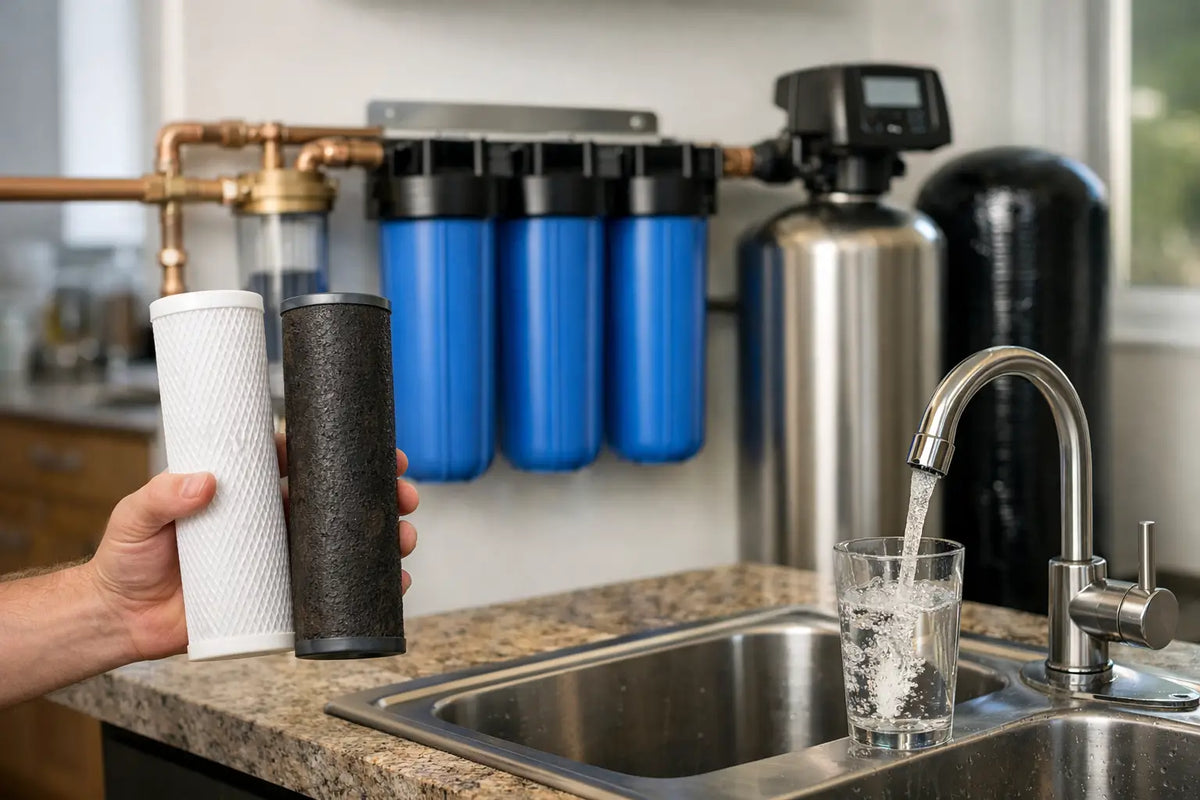
If your shower leaves your skin dry, your ice tastes off, or orange staining keeps showing up around fixtures, you do not need a bigger filter. You need the right one. Knowing how to choose whole house water filtration system options starts with one simple fact: the best system is the one built for your actual water problems, not the one with the longest feature list.
A whole house system treats water as it enters your home, which means every tap, appliance, and shower is affected. That can make a major difference for chlorine taste, sediment, sulfur odors, iron staining, PFAS concerns, and overall water quality. But whole house filtration is not one product category with one answer. It is a group of system types, media, and sizing choices that need to match your water source, your household demand, and the contaminants you are trying to remove.
How to choose whole house water filtration system options
Start with your water source. City water and well water usually require very different treatment strategies.
If you are on municipal water, chlorine or chloramine is often part of the picture. Many homeowners also want to reduce bad taste, odor, sediment, and emerging contaminants such as PFAS. In that case, a carbon-based whole house filter may be a strong fit, but not every carbon system is designed for the same level of contaminant reduction.
If you are on well water, the decision is usually more layered. Sediment, iron, manganese, sulfur, bacteria, and hardness can all show up together. A single tank filter may help one issue while doing very little for another. That is why well water systems are often built in stages, with combinations such as sediment prefiltration, iron or sulfur treatment, UV sterilization, and softening depending on the test results.
Before you compare products, get current water data. That can come from a water quality report, a certified lab test, or a more targeted test based on a known issue. Without that step, buying a whole house system is mostly guesswork.
Match the system to the problem, not the category
A common mistake is shopping by broad label alone. Terms like whole house filter, water purifier, or water conditioner sound useful, but they do not tell you whether a system is built for chlorine, iron, PFAS, sediment, or microbial risks.
Sediment filters are designed to catch dirt, rust, sand, and particulate matter. They help protect fixtures and downstream equipment, but they do not solve taste, odor, or dissolved contaminant issues on their own.
Activated carbon systems are commonly used for chlorine, chemical taste, odor, and some organic compounds. Some are also engineered for stronger reduction of specific contaminants, but performance depends on media type, contact time, and system size.
Catalytic carbon can be a better choice when chloramine or sulfur compounds are involved. It is not automatically required in every home, but in the right application it can outperform standard carbon.
Specialty media systems are often used for iron, manganese, sulfur, acidity, or arsenic. These are highly problem-specific and should be selected based on water chemistry, not assumptions.
UV systems do not filter sediment or chemicals. They are used to address bacteria, viruses, and other microorganisms, usually after proper prefiltration.
Water softeners and salt-free conditioners also deserve a quick clarification. They are not the same as whole house filtration. A softener addresses hardness minerals. A filter addresses contaminants. Some homes need one. Many need both.
One system is not always enough
In real-world installations, the best answer is often a combination. A homeowner on city water may need a sediment filter plus catalytic carbon. A well water property may need sediment removal, iron treatment, UV, and a softener. If your water has multiple issues, a single all-in-one label should be viewed carefully. Convenience matters, but so does performance.
Sizing matters more than many buyers realize
Even a high-quality system can disappoint if it is undersized. Whole house filtration has to keep up with your home at peak demand. That means when someone is showering, the dishwasher is running, and another faucet is on, the system still needs to maintain flow and contact time.
Look at flow rate in gallons per minute and compare it to your household usage. A small home with one or two bathrooms has different needs than a larger home with multiple bathrooms, high-demand fixtures, or a soaking tub. If the filter is too small, you may notice pressure drop, reduced treatment effectiveness, or shorter media life.
This is where many online comparisons fall apart. Buyers focus on price or cartridge count, but the more useful question is whether the system is sized for the number of bathrooms, occupants, and simultaneous water use in the home.
Tank systems vs cartridge systems
Cartridge-based systems are often a practical fit for lighter-duty applications, specific point-of-entry needs, or homeowners who prefer straightforward maintenance. Tank-style media systems are usually better for higher flow rates, longer service intervals, and more demanding whole-home treatment.
Neither is universally better. Cartridge systems can be more affordable upfront and easier to understand. Tank systems often offer stronger whole-home performance and lower maintenance frequency, but they may cost more initially and require more planning for installation space.
Think through maintenance before you buy
The right system should protect your home without becoming a constant project. Every filtration setup has maintenance requirements, but they vary a lot.
Cartridge filters need regular replacement. Media tanks eventually need re-bedding or service. UV systems need annual lamp replacement. Backwashing systems require proper drain access and programming. If a system needs care you are unlikely to keep up with, it is probably not the right fit for your household.
Maintenance is not a downside by itself. It is part of owning effective treatment equipment. What matters is choosing a system with service intervals, replacement parts, and upkeep expectations that fit your budget and routine.
Also pay attention to replacement availability. A lower-priced system can become expensive fast if cartridges are proprietary, hard to source, or need to be changed too often.
Budget for value, not just purchase price
When homeowners ask how to choose whole house water filtration system products, budget is usually part of the conversation. That is reasonable. But it helps to think in terms of total cost, not just the price tag on day one.
A less expensive unit may have a lower upfront cost but shorter cartridge life, more frequent maintenance, lower contaminant reduction, or poor performance at household flow rates. A more capable system may cost more initially while offering longer service intervals, better protection for plumbing and appliances, and fewer compromises at the tap.
Installation costs can also change the equation. Some systems are fairly simple. Others need drain lines, bypass valves, electrical power, or additional treatment stages. If you are comparing options, factor in installation complexity early.
For property owners and commercial buyers, the stakes are even higher. The right specification protects equipment, supports operations, and reduces interruptions. The wrong one can create service calls, inconsistent water quality, and unnecessary replacement costs.
Questions worth answering before you choose
A good buying decision usually comes down to a few practical answers. What is in your water? What are you trying to fix first? How much water does your household use at peak times? Do you need filtration, softening, disinfection, or a combination? How much maintenance are you comfortable with? And how much installation space do you actually have?
If you cannot answer those clearly yet, that is not a reason to delay treatment forever. It is a reason to pause before ordering a generic system. Water treatment works best when the equipment matches the problem.
When expert guidance saves money
Whole house filtration is one of those categories where a quick purchase can become an expensive correction. A family dealing with chlorine taste may only need a properly sized carbon system. A homeowner with well water odor might assume carbon is enough, when sulfur treatment and prefiltration are really needed. A business operator may need a scalable solution with higher flow capacity and more specific performance targets.
That is why consultative support matters. PureWaterGuys helps customers sort through those variables instead of guessing their way through technical specs. For many buyers, that kind of guidance is the difference between buying a filter and buying the right water treatment system.
The best place to start is with your water, your goals, and your home’s demand. Once those are clear, the path gets much simpler. Clean water should feel dependable, not confusing - and the right system should make that obvious every time you turn on the tap.