
June 24, 2026
Salt Free vs Ion Exchange Softener
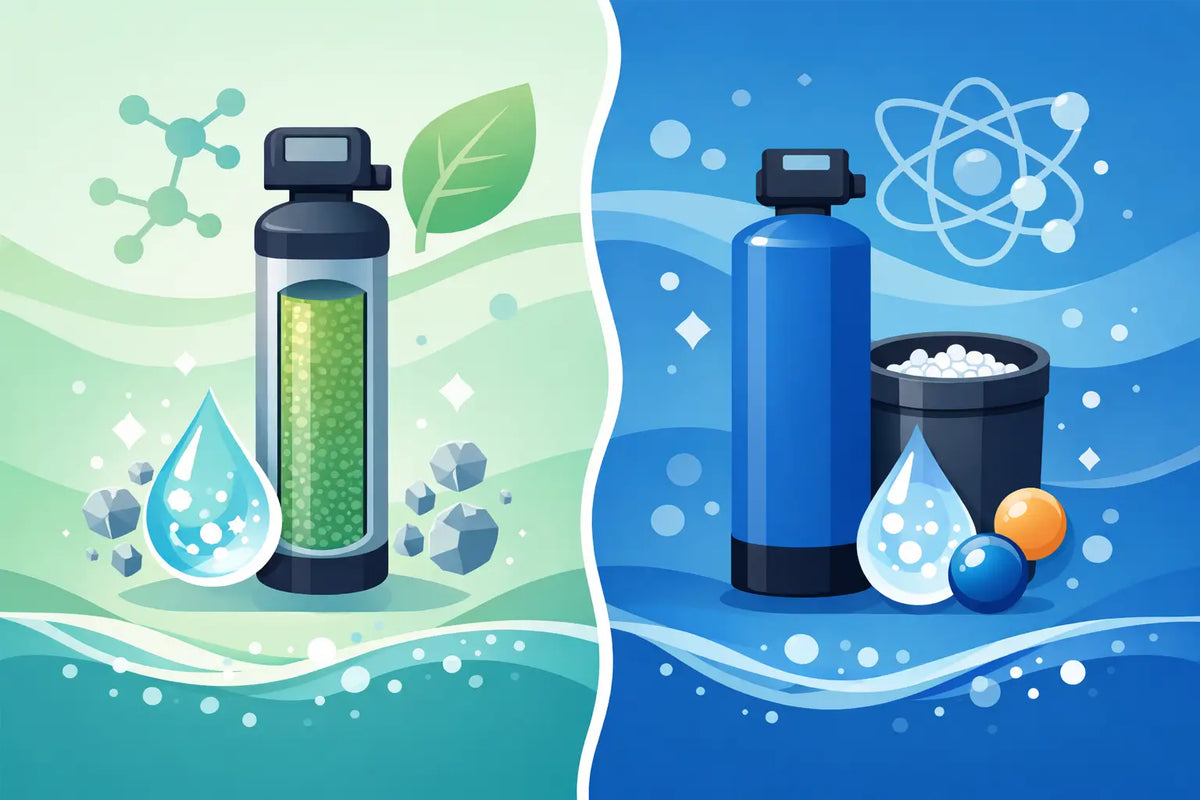
Hard water usually gets your attention the same way every time - white spots on glassware, stiff laundry, scale on fixtures, and a water heater that seems to work harder every year. When homeowners start comparing a salt free vs ion exchange softener, they are usually trying to answer one practical question: which system actually fixes the problem in their home?
The right answer depends on what you mean by hard water treatment. Some people want to stop scale buildup. Others want softer-feeling water for bathing, better soap performance, or longer appliance life. Those goals overlap, but they are not identical. That is why salt-free systems and ion exchange softeners are often confused, even though they work very differently.
Salt free vs ion exchange softener: the core difference
An ion exchange water softener removes hardness minerals, mainly calcium and magnesium, from the water. It does this by swapping those minerals with sodium or potassium. Because the hardness minerals are physically removed, the water is truly softened.
A salt-free system does not remove hardness minerals. Instead, it conditions the water in a way that helps reduce the tendency of those minerals to stick to pipes, fixtures, and appliances as hard scale. The minerals are still in the water, which means the water is not technically soft.
That distinction matters. If your main complaint is scale forming on plumbing and water-using equipment, a salt-free conditioner may help. If your main complaint is soap scum, rough-feeling laundry, dry skin after showering, and poor lather, an ion exchange softener is usually the more direct solution.
How an ion exchange softener works
Inside an ion exchange system, resin beads carry a sodium or potassium charge. As hard water passes through the resin, calcium and magnesium attach to the beads and sodium or potassium is released into the water. Over time, the resin fills up with hardness minerals and must regenerate using a brine solution.
That regeneration step is the reason these systems use salt. It is also why they need a drain connection and periodic salt refills. In return, they provide a proven and measurable reduction in water hardness.
For many households, that translates into obvious day-to-day benefits. Soap rinses more cleanly. Mineral spots decrease. Scale inside pipes, dishwashers, and water heaters is reduced. In homes with very hard water, those improvements can be substantial.
How a salt-free system works
A salt-free system is often called a conditioner or descaler rather than a softener. Different technologies exist, but many are designed to alter how hardness minerals behave so they are less likely to form hard, adhesive scale on surfaces.
Because there is no ion exchange process, there is no salt tank, no regeneration cycle, and typically no wastewater from backwashing for standard residential models. Maintenance can be simpler, and some homeowners prefer that cleaner, lower-touch setup.
The trade-off is equally important: the calcium and magnesium remain in the water. You may still see spotting in some cases, and the water will not have the slippery, softened feel that many people associate with a true softener.
Which system is better for scale control?
If your goal is to reduce scale on plumbing and appliances, both systems can play a role, but they do it in different ways.
An ion exchange softener is generally the stronger option when you want the most complete protection from hardness buildup. Since it removes the minerals causing the scale, it addresses the source directly. In homes with high hardness levels, tankless water heaters, expensive plumbing fixtures, or recurring maintenance issues, this is often the safer bet.
A salt-free conditioner can be a good fit when hardness is moderate and the priority is minimizing scale adherence rather than eliminating hardness minerals from the water. It can be especially appealing for homeowners who want less maintenance or want to avoid carrying salt bags.
If your water is extremely hard, a salt-free system may not deliver the same level of performance you would get from a properly sized ion exchange softener. That is where expectations need to stay grounded in how the technology actually works.
Which system is better for skin, soap, and cleaning?
This is where the difference becomes much clearer.
If you want water that feels soft in the shower, helps soap lather better, leaves less soap residue on tile, and improves laundry feel, an ion exchange softener is usually the better choice. Those benefits come from removing hardness minerals that interfere with soap and detergent.
Salt-free systems do not create that same effect because the minerals are still present. Some homeowners are satisfied if scale is reduced and the system is easy to own. Others install one expecting the feel of softened water and end up disappointed. That usually is not a product failure. It is a mismatch between the system and the goal.
Maintenance and operating costs
For many buyers, ownership matters just as much as performance.
An ion exchange softener requires ongoing salt purchases, occasional cleaning or servicing, and space for both the mineral tank and brine tank. It also uses water during regeneration. Over time, that adds to the operating cost, although many homeowners find the trade-off worthwhile because of the stronger performance.
Salt-free systems usually have lower routine maintenance. There is no salt to refill and often no regeneration cycle to manage. Depending on the media or cartridge design, the conditioning media may need replacement on a scheduled interval, but day-to-day upkeep is lighter.
So if you are comparing convenience, salt-free often wins. If you are comparing hardness removal, ion exchange wins.
Salt free vs ion exchange softener for different homes
The best system often comes down to the property, the water, and what you are trying to protect.
When a salt-free system makes sense
A salt-free conditioner may be a smart choice if your main concern is scale prevention, your water hardness is not extreme, and you want a low-maintenance whole-house solution. It can also make sense for homeowners who prefer not to handle salt or who are focused on a simpler installation footprint.
This option is often considered in newer homes, homes with moderate hardness, or situations where preserving plumbing and fixtures matters more than changing the feel of the water.
When an ion exchange softener makes sense
An ion exchange softener is usually the stronger fit if you have high hardness, visible scale problems, poor soap performance, dry skin complaints linked to hard water, or expensive equipment you want to protect. It is also the better match when you want the classic benefits people expect from softened water throughout the home.
Families, larger households, and properties with multiple bathrooms often see the value quickly because hard water problems tend to multiply with higher water use.
Don’t ignore water testing
Choosing between these systems without knowing your hardness level is a little like buying HVAC equipment without knowing the square footage of the house. Water treatment works best when it is matched to real conditions.
Hardness level is the starting point, but it is not the only factor. Iron, manganese, chlorine, sulfur, pH, and sediment can all affect system selection and long-term performance. In some homes, hard water is only one part of the issue. A complete solution may involve prefiltration, specialty media, or a drinking water system in addition to whole-house treatment.
That is why professional guidance matters, especially if you are investing in a system for a larger home, a well water application, or a light commercial property.
The question to ask before you buy
Instead of asking which technology is better in general, ask which result matters most in your property.
If you want true soft water, better soap performance, and maximum hardness removal, an ion exchange softener is usually the right answer. If you want a simpler system focused on reducing scale formation without salt, a salt-free conditioner may be enough.
Neither system is automatically right for every home. The better choice is the one that matches your water chemistry, maintenance preferences, and the level of protection you need for plumbing and appliances.
At PureWaterGuys, that is the standard worth using for any water treatment decision: solve the actual problem, not just the label on the box.
A good water system should make your home easier to maintain and your water easier to trust. Start with the problem you want solved, and the right choice gets a lot clearer.