
October 10, 2026
Whole House Filter Ratings That Really Matter
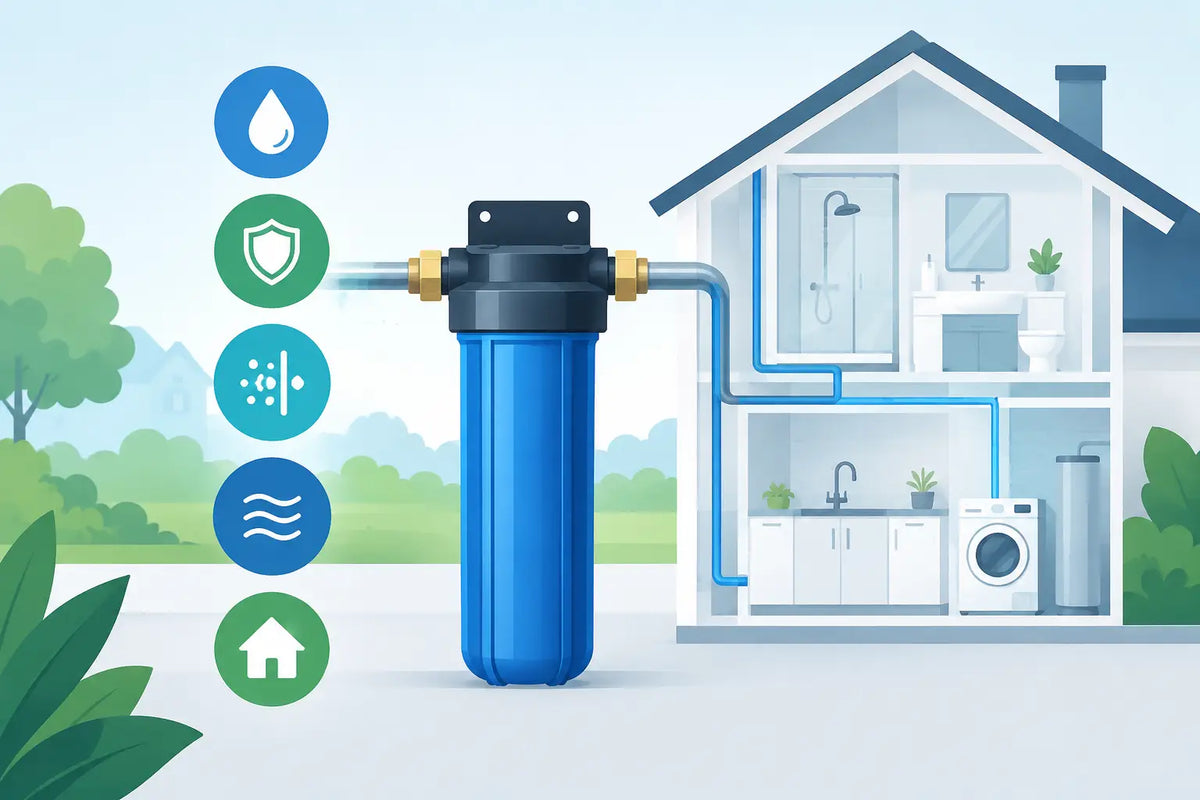
A whole house filter is expected to protect every shower, faucet, appliance, and water-using fixture in the home. That makes whole house filter ratings more than product specifications. They are the details that tell you whether a system can actually keep up with your household, address the contaminants in your water, and avoid creating frustrating pressure loss.
A high rating in one category does not automatically make a filter right for every home. A large family on well water may need a very different system than a city-water household concerned about chlorine taste, lead, or PFAS. The best choice starts with understanding what each rating means in real-life use.
What Whole House Filter Ratings Really Tell You
Filter ratings typically describe five things: what a system removes or reduces, the size of particles it captures, how much water it can treat, how quickly water can pass through it, and whether an independent standard supports its claims. Looking at all five creates a more accurate picture than relying on a product name or a single star rating.
A filtration system can have an excellent micron rating but be poorly suited to chemical contaminants. Another can hold a large amount of carbon media but restrict flow if it is undersized for a home with multiple bathrooms. Ratings need to be read together, with your water source and household demand in mind.
Contaminant reduction claims
Start with the water problem you want to solve. Sediment filters are designed to capture physical debris such as sand, rust, silt, and scale particles. Carbon filtration is commonly used to reduce chlorine, unpleasant taste and odor, and many organic compounds. Specialized media may be used for iron, sulfur, manganese, chloramine, PFAS, or other concerns.
The wording matters. A claim that a filter "improves taste and odor" is not the same as a verified claim for lead, cyst reduction, or PFAS reduction. If a contaminant is a serious concern, look for a system specifically designed for that contaminant and review its stated performance data. For private wells, a current water test is the most reliable starting point. Well water can change seasonally, and visible staining or a sulfur smell may point to problems that ordinary carbon filtration will not fully resolve.
Micron rating: what gets caught
A micron is one millionth of a meter. In practical terms, the smaller the micron rating, the smaller the particles a filter can capture. A 50-micron sediment filter may stop larger grit and protect equipment, while a 5-micron filter captures much finer sediment.
Smaller is not always better. Fine filtration can cause faster pressure drop and require more frequent cartridge changes when water contains heavy sediment. It also does not tell you whether the system removes dissolved chemicals, hardness minerals, or microorganisms. A 5-micron filter is a particle barrier, not a complete water treatment strategy.
Pay attention to whether the rating is nominal or absolute. A nominal rating indicates the filter captures a high percentage of particles around that size. An absolute rating is more stringent and generally reflects a very high percentage of particles at the stated size. Manufacturers do not always use these terms in identical ways, so the full product specifications remain more useful than a micron number alone.
Flow rate and pressure drop
Flow rate, usually measured in gallons per minute or GPM, is one of the most practical ratings for a whole-home system. Your home may use water at several locations at once: a shower running upstairs, a dishwasher filling, and a washing machine cycling. If the filter cannot deliver enough flow, water pressure may feel weak when demand rises.
A typical household should not be sized only for one faucet or one person. Consider the number of bathrooms, people in the home, high-flow shower fixtures, irrigation needs, large tubs, and whether water is supplied to a guest suite or rental unit. Larger homes often need higher-flow tanks, larger-diameter housings, or parallel systems to maintain usable pressure.
Pressure drop is the other half of the equation. Every filter creates some resistance, and that resistance rises as a cartridge collects sediment or media becomes exhausted. A system can advertise a strong maximum flow rate but still perform poorly if it is undersized, installed on restrictive plumbing, or overdue for maintenance. Look for flow and pressure-drop information at realistic operating conditions, not just a maximum number on the box.
How to Compare Whole House Filter Ratings
When comparing systems, begin with your water source. Municipal water often benefits from sediment protection and carbon filtration for chlorine, chloramine, taste, odor, or certain chemical concerns. Well water may require a more tailored approach for sediment, iron, sulfur, bacteria, hardness, or pH imbalance.
Next, match the system capacity to your household's actual use. Capacity may be listed in gallons, months, or years. Gallon ratings are useful, but only when paired with the water conditions that produced them. Carbon media handling heavily chlorinated city water can be depleted faster than the same media treating water with lower chlorine levels. Heavy sediment can also shorten cartridge life long before a projected replacement date.
For homes with variable water quality, staged filtration is often the smarter choice. A sediment prefilter can protect carbon media from clogging, while a specialized treatment stage addresses the primary contaminant. This approach may cost more up front, but it can improve performance and make maintenance more predictable.
Certifications and third-party testing
Independent certifications can add valuable confidence, especially when a system makes health-related contaminant claims. NSF/ANSI standards are common references in water treatment. NSF/ANSI 42 generally addresses aesthetic effects such as chlorine reduction and taste or odor improvement. NSF/ANSI 53 covers certain health-related contaminant reductions. NSF/ANSI 61 is often associated with materials used in drinking-water system components, while NSF/ANSI 372 addresses lead content in wetted components.
Not every effective whole-house system carries every certification. Large tank systems and specialized media configurations are not always certified in the same way as point-of-use cartridges. That does not automatically mean a product is unsuitable. It does mean the buyer should ask better questions: Is the claim certified, independently tested, based on media performance data, or simply stated as a general benefit?
For PFAS, lead, microbial issues, or other high-concern contaminants, choose systems with clear, contaminant-specific documentation. If there is a known bacterial issue in well water, filtration alone may not be enough. UV treatment, disinfection, and source correction may need to be part of the plan.
Service intervals are part of the rating
A system is only protective when it is maintained. Cartridge filters may need replacement every few months to a year, depending on sediment load and water use. Tank-based systems can offer longer media life, but they still require planning for replacement media, backwashing where applicable, and prefilter service.
Before purchasing, confirm four practical details:
- The replacement schedule and expected cost of cartridges or media.
- The inlet and outlet size, so the plumbing does not become a bottleneck.
- The system's rated flow at your home's expected demand.
- The installation space needed for housings, tanks, bypass valves, and servicing.
- Whether your water problem requires a water test before selecting equipment.
Choose for Your Water, Not a Generic Score
Customer reviews can help reveal installation experience, durability, and support quality, but they cannot diagnose your water. A five-star review from a homeowner treating mild city-water chlorine does not guarantee the same result for a family managing high iron and sulfur from a private well.
Use reviews as one part of the decision, then compare the system's technical ratings against your water report, plumbing size, and peak household demand. If you are uncertain, expert guidance can prevent expensive mismatches, particularly for well water, PFAS concerns, commercial kitchens, multi-unit properties, and homes with several bathrooms.
The right whole-house filter should feel quiet in the background: clean-tasting water, protected fixtures, dependable flow, and a clear maintenance plan. Start with what is actually in your water, then choose ratings that support your family's needs at every tap.