
September 12, 2026
Whole House Sediment Filter Review for Your Home
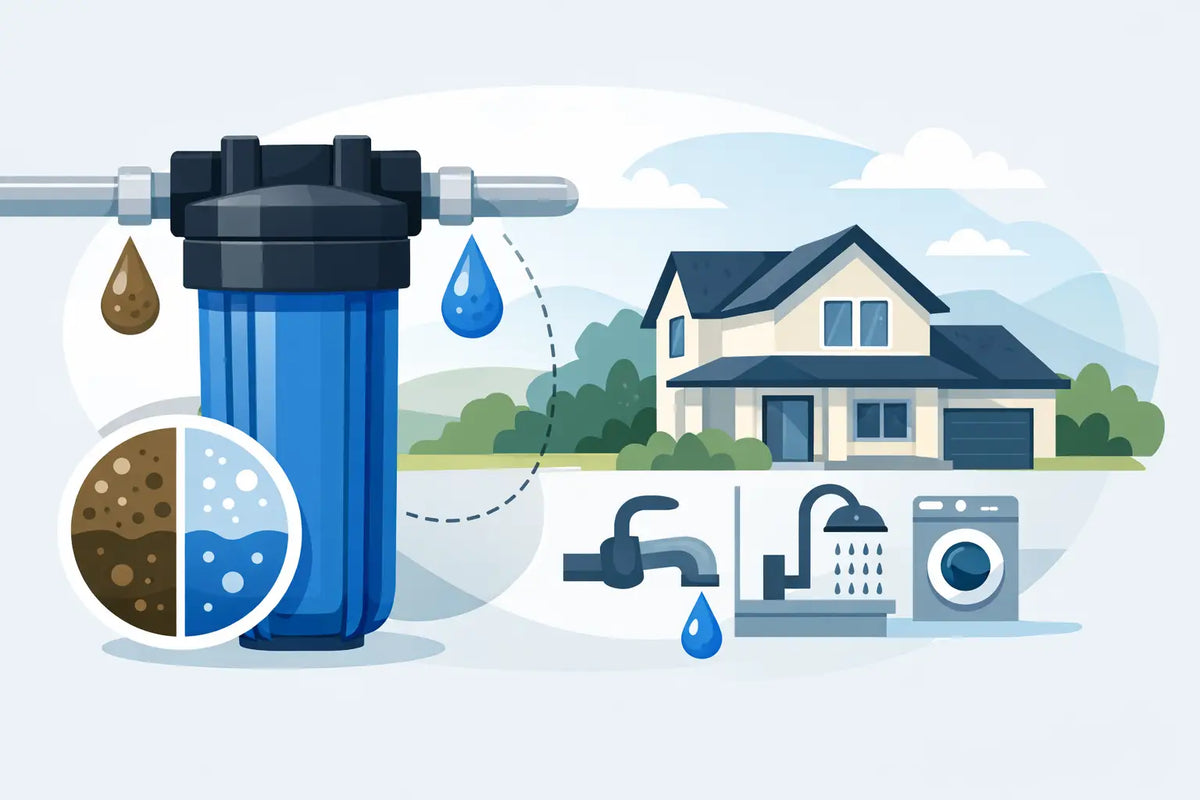
A brown ring in the toilet bowl, grit caught in faucet aerators, or a pressure drop after heavy water use can point to one basic problem: sediment is moving through your home's water lines. A whole house sediment filter review should start there, not with the lowest price or the biggest housing on the page. The right system protects fixtures, appliances, and downstream treatment equipment while maintaining the flow your household needs.
Sediment filtration is often the first line of defense for homes on private wells, but municipal-water homes can benefit too. Rust flakes from aging pipes, sand, silt, construction debris, and scale particles can all affect water clarity and equipment performance. The best choice depends on what is in your water, how much water your home uses, and whether the sediment filter will support other treatment equipment.
What a Whole House Sediment Filter Actually Does
A sediment filter is installed near the main water entry point, before water reaches faucets, water heaters, washing machines, ice makers, and treatment systems. It captures suspended particles. It does not soften hard water, remove dissolved iron, disinfect water, or reliably address chemicals such as chlorine or PFAS unless it is paired with media designed for those contaminants.
That distinction matters. A filter may make cloudy water look better while doing little to correct a sulfur odor or a high bacteria result. If your water has multiple concerns, sediment removal may be one stage in a larger whole-home solution.
For many properties, removing particles first extends the working life of carbon filters, UV systems, water softeners, valves, and reverse osmosis prefilters. Sediment can clog fine filtration stages quickly. Addressing it at the point of entry helps keep the rest of the system working as designed.
Whole House Sediment Filter Review: The Specs That Matter
A useful review looks past broad claims such as "high capacity" and checks four practical specifications: micron rating, flow rate, filter design, and housing size. Each one affects daily water pressure, maintenance frequency, and the level of protection you receive.
Micron rating determines what the filter can catch
A micron is a very small unit of measurement. The lower the micron rating, the finer the filtration. A 50-micron filter is intended for larger particles such as visible sand or pipe debris. A 20-micron filter is a common starting point for general whole-home sediment control. A 5-micron cartridge catches finer sediment and is often used ahead of UV treatment or carbon filtration.
Finer is not automatically better. A 1- or 5-micron filter can load up fast when well water carries heavy silt, causing pressure loss and frequent cartridge changes. In a high-sediment application, a staged approach often makes more sense: use a larger-micron prefilter to catch the bulk of debris, then a finer cartridge downstream if needed.
If your water has visible grit, begin with a larger rating or consider a reusable spin-down filter. If the concern is fine cloudiness, sediment showing up in cartridge housings, or protecting a UV unit, a finer stage may be justified.
Flow rate protects real-world water pressure
A filtration system must keep up when someone showers, the dishwasher runs, and a toilet refills at the same time. Flow rate is generally shown in gallons per minute, or GPM. A filter can technically fit your plumbing but still become a bottleneck if its rated flow is too low for the property.
Smaller standard housings can work for a modest household with relatively clean city water. Larger Big Blue-style housings, commercial-grade housings, or high-flow systems are a better fit for larger homes, multiple bathrooms, high-demand fixtures, and well systems with significant sediment.
Pay attention to pressure drop, not just the advertised GPM. Every filter creates some resistance, and resistance rises as the cartridge collects debris. A properly sized housing gives you more usable filter surface area and typically holds pressure more consistently through the cartridge's service life.
Filter material affects service and performance
Pleated sediment cartridges are often washable and reusable several times, depending on water conditions. They provide a large surface area and are a practical option for coarse sand, rust, and visible particulate. They are not always the best choice for very fine silt.
Melt-blown depth filters capture particles throughout the filter media rather than only at the outer surface. They are effective for finer sediment and commonly used in multi-stage systems. Their trade-off is that they are generally disposable.
String-wound cartridges are another dependable option for sediment-heavy water. Their layered construction can handle a range of particle sizes, though replacement intervals still depend on loading. No cartridge is maintenance-free. The right question is whether the maintenance schedule is predictable and reasonable for your water source.
Housing size is more than a convenience feature
A larger housing usually means a longer cartridge, more media surface area, less frequent replacement, and better flow potential. For many single-family homes, a 20-inch large-diameter housing is a strong baseline. It is especially valuable when a home has several bathrooms, a large family, or sediment that would exhaust a smaller cartridge quickly.
Compact 10-inch housings have a place in low-demand applications or as targeted prefilters, but they may require more frequent service at the whole-house level. Choosing a housing that is too small can turn an affordable purchase into a recurring maintenance frustration.
Choosing by Water Source and Problem
City water and well water create different filter decisions. Municipal water may carry intermittent rust, scale particles, or sediment stirred up by nearby water-main work. A simple cartridge system is often sufficient when the problem is occasional and the water is otherwise clear.
Well water is less predictable. Sand, silt, clay, iron particles, and seasonal changes can increase cartridge use. If a cartridge turns brown or becomes restricted unusually fast, a standard filter alone may not be the most economical answer. A spin-down separator, backwashing sediment system, or specialized well-water treatment setup can reduce ongoing cartridge costs.
If you see orange staining, do not assume it is ordinary sediment. Iron can be dissolved in water and pass through a basic sediment filter before oxidizing and leaving stains. Likewise, a rotten-egg smell may indicate hydrogen sulfide, which requires a different treatment strategy. Water testing helps separate a particle problem from a dissolved contaminant problem.
Installation and Maintenance Considerations
Whole-house sediment filters are commonly installed on the main water line after the pressure tank for well systems or after the main shutoff where local plumbing requirements allow. They should be accessible. A filter tucked behind finished walls or installed without shutoff valves becomes difficult to service when it is time to replace a cartridge.
A pressure gauge before and after the filter is one of the most useful additions to a whole-house system. The difference between those readings shows when the cartridge is becoming restricted. Instead of guessing whether a filter is dirty, you can replace it based on actual pressure loss.
Plan for cartridge changes before buying. Confirm replacement availability, cartridge dimensions, housing connection size, and the cost of the filters you will use over time. A system with inexpensive upfront pricing can cost more if it requires frequent proprietary cartridges or undersized replacements.
For well owners, check the filter after the first few weeks. That early inspection tells you far more about your maintenance needs than a generic change schedule. Once you understand how quickly your water loads the cartridge, you can set a reliable service routine.
When a Sediment Filter Should Be Part of a Larger System
A sediment filter is an excellent solution when particulate matter is the primary concern. It is also a critical supporting component for homes installing carbon filtration, UV disinfection, softening, or reverse osmosis. But it should not be asked to solve every water issue.
Consider a broader treatment approach if you have persistent odor, hardness scale, bacteria concerns, high iron or manganese, chemical contaminants, or tested PFAS. The most effective system is built around water quality results and household demand, not a one-size-fits-all filter package.
PureWaterGuys helps homeowners and property operators match filtration equipment to the actual water problem, whether that means a straightforward sediment housing or a complete well-water treatment design. A few details about your water source, plumbing size, number of bathrooms, and test results can prevent costly guesswork.
Start with the evidence in your water and the demands of your home. A correctly sized sediment filter can quietly protect the plumbing and equipment you rely on every day, while giving any downstream treatment system a cleaner foundation to do its job.